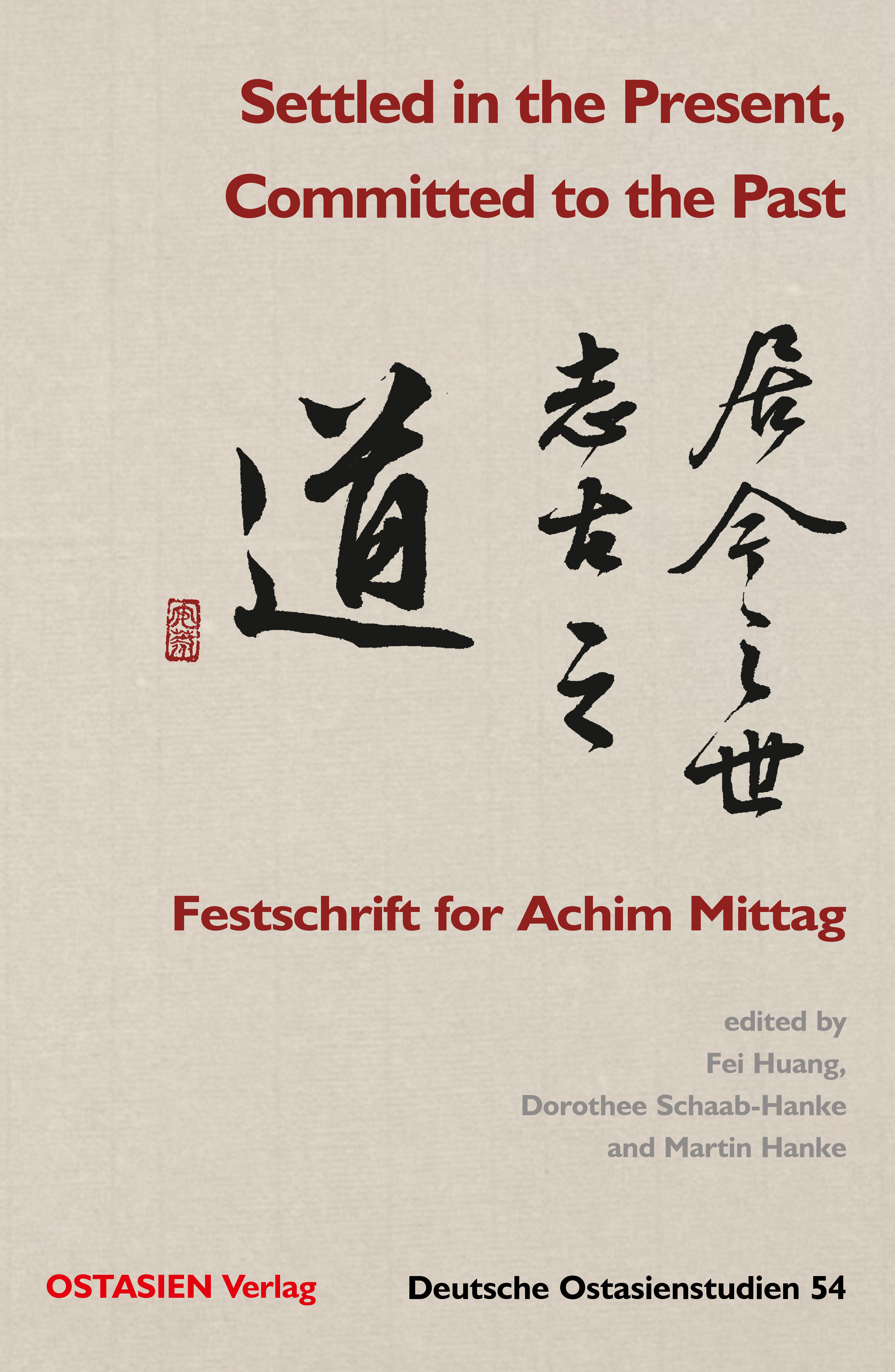
Settled in the Present, Committed to the Past:
Festschrift for Achim Mittag on the Occasion of His 68th Birthday
|
Fei Huang, Dorothee Schaab-Hanke and Martin Hanke (eds.)
Deutsche Ostasienstudien 54
OSTASIEN Verlag
Softcover (17,6 x 25,0 cm), xiv + 509 pp.
July 2026. € 59,80
ISBN-13: 978-3-911262-04-0 (978-3911262040, 9783911262040)
ISBN-10: 3-911262-04-3 (3911262043)
Vertrieb: CHINA Buchservice / Bestellen |
|
| |
|
The essays assembled in this volume have been contributed by long-standing collaborators, colleagues and friends and also by some of Achim Mittag’s former students. The contributors are from Germany, the Netherlands, North America, China, and Taiwan, who came to know Achim Mittag through conferences, research projects, and sustained scholarly conversations, as well as through the daily university work, and they all have enriched his life and academic career. If one reads the 29 articles contributed by altogether 30 contributors attentively, one will find that most of them discuss topics that Achim Mittag himself has already explored in one way or another and that the authors explicitly refer to these talks or publications. What holds the contributions together is a shared interest: a curiosity to know more than was hitherto known or thought, and to scrutinize a detail that turns out to be a piece of the puzzle that makes up the bigger picture.
The volume is divided into eight thematic sections, namely Part I: „Macrohistory Versus Microhistory“, Part II: „Between Historical Geography and Travelogue“, Part III: „Working on Texts“, Part IV: „Society versus Individual“, Part V: „Intellectual Debates in China’s Past and Present“, Part VI: „Memory Culture and Identity“, Part VII: „Early Cultural Encounters with China and the Beginnings of Sinology“, and Part VIII: „China Expertise and ‘Greater China’“.
The contributors to this volume are, in alphabetical order:
Patrick Aberle, Elisabeth Biebl, Cao Jin, Jan de Meyer, Anno Dederichs, Sebastian Demuth, Emily Graf, Qijin Han, Martin Hanke, Fei Huang, Alexander Jost, Thomas H.C. Lee, Jürgen Leonhardt, Christine Moll-Murata, Michael Nylan, Jörn Rüsen, Hermann-Josef Röllicke, Dorothee Schaab-Hanke, Philip Scherer, Jonas Schmid, Helwig Schmidt-Glintzer, Angela Schottenhammer, Gunter Schubert, Barend ter Haar, Ulrich Theobald, Hoyt Tillman, Hans van Ess, Hans Ulrich Vogel, Wang Weijiang , Zhang Zhirui |
|
|
|
Contents [PDF]
Introduction [PDF]
Part I Macro-History versus Micro-History
Jörn Rüsen
Reconsidering Narrative Competence: Basic Features of the Logic of Historical Consciousness
Hermann-Josef Röllicke
Die Weltgeschichte Deiner Seele: Der Buddha als seine eigene „Geschichte“
Ulrich Theobald
The Mutiny of 1560: Testing Zhu Guozhen’s Yongchuang xiaopin as a Source of Micro-History [PDF]
Sebastian Demuth
The Localization and Rediscovery of the Boxer Fort Hophu [PDF]
Part II Between Historical Geography and Travelogue
Elisabeth Biebl
Neue Welten mit altem Wissen beschreiben: Vom Chinawissen zwischen den Zeilen in Albrecht Herports Eine kurtze Ost-Indianische Reis-Beschreibung
Martin Hanke
Emanuel Bowen als Kartograph und Kritiker von Du Haldes Description und den Karten von d’Anville [PDF]
Angela Schottenhammer
Geographical Knowledge and Maps of Don José Camacho y Brenes, First Pilot of the Royal Spanish Navy Stationed at San Blas [PDF]
Part III Working on Texts
Michael Nylan
A Puzzle Piece from Guoyu
Barend ter Haar
The Impact of the Witchcraft Affair on Kong Anguo and Sima Qian
Hans van Ess
Einige Gedanken zum Gedicht “Die vorzügliche Person” von Du Fu
Dorothee Schaab-Hanke
Qin-Musik und Emotionen: Frühe chinesische Ansätze zu einer Musikästhetik und deren Rezeption in der Song-Zeit [PDF]
Fei Huang 黄菲
Zhu Xi’s Hot Springs Encounter and His Annotation on “yu hu Yi” (Bathing in the Yi River) in the Analects
Part IV Society versus Individual
Hoyt Cleveland Tillman
Some Backstory of Contested Relationships between Filiality and Loyalty in China [PDF]
Jan A. M. De Meyer
Qin Xi: A Mid-Tang Recluse and his Rhetoric of Refusal
Jonas Schmid
Von heiligen Einsiedlern in den Bergen: Bemerkungen zu einem jesuitischen Text der späten Ming-Zeit
Part V Intellectual Debates in China’s Past and Present
Philip Scherer
Yangzhou Scholars as Driving Forces of the Development and Institutionalization of Guoxue
Wang Weijiang 王維江
Die Verstrickungen des Pan Zuyin [PDF]
Han Qijin 韓奇金
From Imperial Legacy to National Identity: Revisiting the Debates of 1905–1907 on Ethnicity in China based on a Digital Textual Analysis
Part VI Memory Culture and Identity
Zhang Zhirui 張之瑞
The Dynastic Pattern Between Rupture and Continuity: Royal Travels, Tianxia, and the Cosmo-Political Reconfiguration of the Mid-Western Zhou
Emily Graf
A “Bronze Woman” among “Bronze Men”: Random Notes on Thinking about the Body in Medical Museums in China [PDF]
Christine Moll-Murata
War, Peace and Trauma 2.0: Hangzhou in and after the Taiping Rebellion
Thomas H. C. Lee 李弘祺
National Palace Museum and the “Other” Museums in Taiwan: The Competition of Memory Creation
Part VII Early Cultural Encounters with China and the Beginnings of Sinology
Hans Ulrich Vogel
“Et in summitate cuiuslibet columpne est draco magnus circumdans totam columpnam, …”: Marco Polo on the Dragon Columns of the Great Khan’s Bamboo Palace in Shangdu [PDF]
Patrick Aberle
How to Devise a New Term: The Jesuits’ Approach of Introducing Novel Concepts through Old Knowledge in Ming China
Cao Jin 曹晉 and Alexander Jost
From “Exploitation of Materials” to “Completion of Implements”: Eastern and Western Technology through the Lens of Xu Guangqi’s Kaicheng jiyao (Record of the Essentials of Exploitation and Completion)
Jürgen Leonhardt
The Lutheran Theologian Johann Benedict Carpzov on the Chinese Philosopher Mengzi: Scholarly Knowledge at a German University in the 18th Century
Part VIII China Expertise and “Greater China”
Helwig Schmidt-Glintzer
Vertrauen auf Generationen, der unlösbare Knoten und die Einsamkeit des Langstreckenläufers
Gunter Schubert
“Greater China”: A Conceptual Approach [PDF]
Anno Dederichs
Hochschulkooperation mit China: Perspektivwechsel
Abstracts (in alphabetical order of the authors’ names) [PDF]
List of Publications by Achim Mittag [PDF]
Tabula Gratulatoria [PDF]
|
|
| |
|
| |
|
Introduction |
|
| |
|
In his personal remarks introducing the “Table According to Years of Meritorious Ministers and Marquises enfeoffed by Gaozu” (Gaozu gongchen houzhe nianbiao 高祖功臣侯者年表) in Chapter 18 of the Shiji 史記 (The Scribes’ Records), the historian – be it Sima Qian 司馬遷 (c. 145–c. 86 BCE) or already his father Sima Tan 司馬談 (?–110 BCE) – wrotex:
居今之世,志古之道,所以自鏡也,未必盡同。
Being settled in the present, but committed to the way of the past, one can use [the past] as a mirror [of the present], however, [the circumstances] are not necessarily completely the same. (Shiji 18.878)
What follows after this remark is a table that lists more than a hundred marquisates enfeoffed by Liu Bang 劉邦 (posthumously Gaozu 高祖, r. 206–195 BCE), the founding emperor of the Han 漢 dynasty, and which had collapsed within barely a hundred years. The ancient enfeoffed states of earlier dynasties, by contrast, had endured for centuries. The contrast demanded an explanation, and the explanation points toward the Dao 道: the principles that the ancient lords had held onto, and which the Han marquises seem to have had let go of. Or was it perhaps meant as a criticism directed at the new centralized government as compared with the ancient system of the Zhou 周 with its feudal states?
Whatever the true intention behind these words was, what matters most here is the lesson that the historian draws from the observation of things past. The first part of his statement is rooted in early Confucian thinking. It is in Chapter 12 of the Xunzi 荀子 text that we find the instruction directed at how a gentleman (junzi 君子) should behave, namely that “While living in the present, he will be committed to the way of the past” (sheng yu jin zhi shi, er zhi hu gu zhi dao 生乎今之世,而志乎古之道).
However, it would be too simplistic to conclude from this that the historian here merely wants to express his own strong inclination towards Confucian values. Rather, one finds similar notions both in the Zhanguoce 戰國策 and also in Jia Yi’s 賈誼 (200–168 BCE) famous essay “Guo Qin lun” 過秦論 that analyses sharply the reasons for the sudden downfall of the Qin 秦 (221–206 BCE) dynasty. The important detail in which the historian’s statement differs from all these earlier accounts is that he adds that “[the circumstances] are not necessarily completely the same” (wei bi jin tong 未必盡同), and this is exactly what makes Sima Qian (or already Sima Tan) such an exceptional historian.
It is for this reason that we have chosen this quotation from the Shiji as the governing word of this volume. The essays collected here are offered in honor of Prof. Achim Mittag (Chinese name: Min Dao’an 閔道安), a scholar who has devoted much of his academic research to questions related to Chinese historiography.
Achim Mittag was born in Einbeck in 1958 and began his studies of Sinology, Medieval and Modern History, and Philosophy at the University of Munich, where he was formed under leading Sinologists such as Herbert Franke (1914–2011), Wolfgang Bauer (1930–1994), and Helwig Schmidt-Glintzer (*1948). He extended his linguistic and scholarly grounding at Fu-jen University (Furen daxue 輔仁大學) in Taiwan (1981/1982), after which he spent, with a scholarship of the German Academic Exchange Service (DAAD), two formative years at Fudan University (Fudan daxue 復旦大學) in Shanghai (1984–1986), during which he studied under the supervision of the eminent historian Zhu Weizheng 朱維錚 (1936–2012) and also met his future wife, Zhu Dan-wei 朱丹薇. The topics he had explored during his studies also shaped his subsequent academic career. In his Master’s thesis finalized in 1984 he examined the historical thinking of the Song dynasty scholar Zheng Qiao 鄭樵 (1104–1162); his doctoral dissertation, finished in 1988 and published in 1993, offered a reconsideration of Song Classical Learning focusing on the Shijing 詩經 (Classic of Odes) scholarship. The years that followed were marked by the necessity of post-doctoral mobility, moving between the Center for Interdisciplinary Research (ZiF) of Bielefeld University, the International Institute for Asian Studies (IIAS) of Leiden University, the University of Marburg, the City College of New York (CCNY), and the Kulturwissenschaftliches Instititut Essen, until in 2005 he was appointed to a permanent professorship at the University of Tübingen. From 2005 to 2024, he held the chair for Chinese Language, Literature, and Philosophy at the University of Tübingen, and since his retirement in Summer 2024 he remains committed to the Department of Chinese Studies as Senior Professor.
Achim Mittag’s teaching in Tübingen has been inseparable from his scholarship driven by a single conviction: that the ancient Dao remains alive only insofar as it is brought into genuine contact with the present. Taking its inspiration from the three-volume-teaching book by Harold Shadick and Chien Ch’iao, A First Course in Literary Chinese, he conceived a Classical Chinese textbook of his own, entitled “Wenyanwen 文言文 – Ein Lehrbuch des Klassischen Chinesisch und der chinesischen Schriftsprache auf der Grundlage des ‚Grammatik-Buddhas‘” (A teaching workbook of Classical Chinese and Written Chinese based on the “Grammar-Buddha”). It was developed and refined over many years of teaching, with the assistance of students and PhD candidates, but has not been published so far. In this textbook, he assigns each part of speech and sentence element to a part of the Buddha figure’s body, offering students a concrete, visual anchor for grasping the grammar and sentence structure of Classical Chinese poetry, prose, and philosophical texts. It is built on precisely this principle: that Classical Chinese is not a dead language to be deciphered but a living presence in contemporary song lyrics, modern poetry, political rhetoric, and everyday speech. The ancient and the modern illuminate each other; the task of the teacher, as of the historian, is to make that illumination visible.
To carry the Dao forward is to see oneself not merely as an individual trying to live well, but as a link in a chain, indebted to those who came before and responsible to those who come after. The clearest evidence of this in Achim Mittag’s career is what he has done for the people and institutions gathered around the yellow building of the Department of Chinese Studies at Tübingen from 2005 to 2026 (he has described the department building as a “humble abode” of Sinologists (armselige Hütte), to borrow the spirit of Liu Yuxi’s 劉禹錫 (772–842) “Inscription on My Humble Abode” (Loushi ming 陋室銘): “O, meine armselige Hütte! Allein meine Lauterkeit ist’s, wovon sie zehrt.”) Here he and his colleague, Hans Ulrich Vogel, established the language training and exchange programme at Peking University, built up international research projects on Chinese and comparative historiography, and pursued those on such inspiring themes as collective identity and historical trauma, among others. His care for students has been of the same quality as his care for texts: attentive, patient, and genuinely concerned with the individual person and his or her needs. This is also evident in the doctoral dissertations, Master’s theses, and BA theses he supervised, as well as in his dealing with questions of his students which he always took very seriously. He has also offered mentorship and support to junior colleagues without reserve, and did whatever was within his power to help the next generation find their footing. All of this brought scholars and students from several generations and various traditions into sustained, productive conversation with him.
Starting from Vol. 49 (2015) and ending with Vol. 59 (2025), altogether eleven years, Achim Mittag edited, together with Dorothee Schaab-Hanke, the Journal of Asian History published by Harrassowitz, the last two issues also in cooperation with Sebastian Eicher (Ca’ Foscari University of Venice). During their editorship, the journal’s geographical scope was fixed on being as vast as Asia itself, and its historical scope encompassed all periods up to around 1900. Yet a special accent was placed on what they called the “Through the Looking-Glass” aspect of history. Contributors were encouraged to explore particular phenomena or events that reveal the dynamics of historical processes, elucidate changes at historical turning points, and trace the larger developments resulting from these.
The essays assembled in this volume have been contributed by long-standing collaborators, colleagues and friends, students and former students of Achim Mittag. The contributors are from Germany, the Netherlands, Belgium, France, Spain, Austria, North America, Mainland China and Taiwan, who came to know him through conferences, research projects, and sustained scholarly conversations, as well as through the daily university work, and they all have enriched his life and academic career.
The volume is divided into eight thematic sections. In the opening Part I, “Macrohistory Versus Microhistory”, two contributions deal with the broader perspectives on history and historiography, while two other studies concentrate on case studies which, however, likewise shed light on further-reaching questions of recording history. Jörn Rüsen’s focus is put on the question of historical consciousness which he defines as something that evokes the past as a mirror of experience into which the present looks in order to learn something about its future. Hermann-Josef Röllicke contemplates the profound incompatibility of the conventionalised Western term “history” with the German word “Geschichte”, and argues against the idea of the “historical Buddha” while making a case for thinking the “Buddha” anew in the sense of the “Buddha as his own Geschichte”. Based on a text of the genre “brush notes” written in the mid of the 16th century, Ulrich Theobald analyses the account of a military revolt that had happened in 1560, mixing the report of the incident itself with the author’s reflections on the protagonists’ personal experiences. Sebastian Demuth, whose great-grandfather had been a member of the German East Asian Expeditionary Corps, traces the reports concerning a Boxer outpost in the region north of Beijing and reconstructs the location of Fort Hophu.
Part II, “Between Historical Geography and Travelogue”, sets out with Elisabeth Biebl’s account of Albrecht Herport’s book Eine kurtze Ost-Indianische Reis-Beschreibung (A Brief Description of an East Indian Journey) published in 1669. Though Herport had in fact served as a soldier in the Dutch East India Company and thus possessed solid firsthand knowledge of Formosa, he deliberately suppressed part of his knowledge in favor of fanciful stories. In doing so, he and his publisher crafted the report more in the manner of an adventure novel, calculated to attract greater attention. In stark contrast, Martin Hanke examines the maps drafted exclusively for the second English edition of Jean-Baptiste Du Halde’s Description Géographique, Historique,Chronologique, Politique, et Physique de l’Empire de la Chine et de la Tartarie Chinoise (The General History of China), demonstrating how they reflect the most current geographical and cartographic knowledge available in Britain at the time. Besides, he argues that both the maps with their legends and the translations of two volumes published between 1738 and 1741 were the work of a single person, identifiable as the Welsh cartographer Emanuel Bowen (ca. 1693–1767). A broader perspective is taken by Angela Schottenhammer who deals with Don Joseph Camacho y Brenes (fl. 1770s to 1780s; d. 1795), graduate naval lieutenant and first pilot of the Royal Navy, who sailed the Spanish American coasts and the Pacific and drew many maps. The focus of her study lies on Camacho’s transpacific voyage to the Philippines and his related maps.
Part III, “Working on Texts”, assembles texts which are scrutinized by using philological approaches. Michael Nylan writes that she wanted to offer Achim Mittag, from whom she had “learned so much over the years”, a puzzle piece drawn from the Guoyu (Advice from the States). Her focus lies on the “Zhengyu” section of the work which in her view differs from other sections of the Guoyu, especially in its special rhetoric, and she asks herself what the message of that section is with regard to how the function of history should be understood. Another riddle is presented by Barend ter Haar who discusses the possible impact of the “Witchcraft Affair” on the so-called Old Text-New Text Controversy and the fate of the scholar Kong Anguo (late second century BCE) and some of his contemporaries in its aftermath. Hans van Ess focuses on a famous poem by the Tang poet Du Fu titled “Jiaren” which was rendered by David Hawkes as “A Fine Lady”. Comparing his translation with those by Erwin von Zach, Stephen Owen, and others, he argues that translations informed by traditional commentaries, like von Zach’s, capture the author’s intent better than those that rely on the text alone. Dorothee Schaab-Hanke’s paper intends to add a facet to Achim Mittag’s research on the musical aspect of the Shijing as it has been formulated by Song scholars Zheng Qiao and Zhu Xi. She analyses the role of the yuefu and of the Qincao pieces reckoned among this category, as successors of the Shijing songs, whose musical aspect had long been neglected. Fei Huang’s contribution resonates with Achim Mittag’s interests in Zhu Xi’s annotations on the Confucian canon. Her starting point is a passage from the Lunyu (Analects) in which the disciple Zeng Dian mentions his fondness for bathing in the River Yi. The precise meaning of this remark occupied Confucian scholars for centuries. Among their readings, she singles out Zhu Xi’s commentary, asking how his interpretation may have been shaped by his own experience of visiting hot springs.
In Part IV, “Society versus Individual”, Hoyt Tillman muses on a topic that was inspired by the conference on “Collective Identity, Experiences of Crisis and Traumata” organized by Achim Mittag in 1998, namely the question of how the Song scholar Zheng Sixiao (1241–1318) dealt with the conflict between loyalty and conflict which seems to have been an unsolvable dilemma to him. Jan de Meyer discusses the question whether the poems of Qin Xi (c. 725–c. 805), whom he denotes as a “lifelong hermit” and not someone who went into retirement after long years of service, should be read as direct reflections of his life in reclusion or rather as rhetorical devices. Hermits are also the topic of Jonas Schmid’s paper, though his study takes a different route: it is based on a text by the Jesuit missionary Alfonso Vagnone (1568–1640), who produced a Chinese version of Pedro de Ribadeneira’s (1526–1611) Flos Sanctorum. The lives of Christian saints and hermits thus served Vagnone as a European counterpart to the Chinese tradition of recluses who had withdrawn to the mountains.
Part V, “Intellectual Debates in China’s Past and Present”, starts with a text by Philip Scherer who traces the development and institutionalization of Guoxue (National learning) starting with the late Qing to the year 2024 by taking Yangzhou as his point of departure. The focus of Wang Weijiang’s study lies on Pan Zuyin (1830–1890), a member of a family of illustrious statesmen. He traces his career which initially advanced smoothly but was time and again thwarted by setbacks, some of which were personal and some political in nature. As Wang argues, Pan’s biography to some degree also mirrors the broader predicament of his era. The text contributed by Han Qijin examines Chinese intellectual debates on ethnicity between 1905 and 1907 through a digital textual analysis. By analysing word frequencies, relative keywords, and textual sources in reformist and revolutionary writings, the chapter reconsiders the patterns of this debate. It argues, counterintuitively, that the reformers’ conceptual toolkit was more progressive than is usually assumed, while that of the revolutionaries remained more strongly shaped by traditional notions.
Part VI, “Memory Culture and Identity”, assembles four texts. Zhang Zhirui’s contribution reconsiders the Southern Campaign of King Zhao (r. 977/975–957 BCE) of the Western Zhou period. Drawing on the concept of trauma that Achim Mittag introduced to him as a disruption that demands narrative coherence, he argues that the ideal of “Kingly Government”, grounded in ethics and cultural transformation rather than conquest. It provides an alternative explaination on why the Zhou royal house abandoned further expansion after the decimation of its army. In dialogue with Achim Mittag’s discussion of premodern Chinese concepts of the body, Emily Graf’s article examines a bronze figure cast in the eighteenth century (ca. 1744) depicting a nude female body with acupuncture points engraved on it. She interprets this exceptional figure as breaking with the conventions of how the human body was visualized prior to the Qing within the court, among high-ranking officials, and among physicians. This break was closely tied to the Qing court’s explicit ambition to establish a new orthodoxy of medical knowledge. She further traces how that knowledge continues to be presented in contemporary Chinese medical museums. Christine Moll-Murata re-examines Achim Mittag’s thesis that the young Zhang Taiyan (1869–1936) had praised the Taiping struggle against the Manchus in his 1908 writings. Her own findings are based on an examination of Zhang’s record on a shrine erected in Hangzhou in 1895, dedicated to the victims of the Taiping Rebellion, included in the memorial collection Gengxin qi Hang lu (Weeping for Hangzhou in the Gengxin and Xinyou Years [1860–1861]). She argues that Zhang used the Taiping Rebellion as a dark mirror through which to reflect on the complex situation following the First Sino-Japanese War. Thomas H.C. Lee approaches memory culture and identity through the lens of museum conception, focusing on the National Palace Museum Taipei in comparison with what he calls the “other” museums. While the National Palace Museum, completed in 1965, was designed from the outset to support the Nationalist Party’s claim to legitimate Chinese representation, many of the newly built “other” museums, Lee argues, reflect local Taiwanese culture or evoke memories of Japanese colonial life, a sensibility he labels “anti-post-colonial”.
Part VII, “Early Cultural Encounters with China and the Beginnings of Sinology”, engage two of Achim Mittag’s central themes: the history of knowledge and early Sino-European intellectual exchange. Hans Ulrich Vogel deals with the notion of dragon columns as they are recorded in two text families of Le Devisement dou monde ascribed to the Venetian merchant and traveler Marco Polo (1254–1324) and argues that the description of this architectonical adornment can be taken as further evidence that Marco Polo had indeed stayed in China. Patrick Aberle examines the novel terminology in the Celiang fayi (Meanings and Methods of Measurement), a 1608 collaboration between Xu Guangqi (1562–1633) and the Jesuit Matteo Ricci (1552–1610), treating it as both an encounter between two mathematical traditions and a case study in translation. His analysis focuses in particular on the Jesuits’ deliberate linguistic and translational strategies for introducing and adapting technical terms at the interface of these two traditions. Cao Jin and Alexander Jost focus on another work by Xu Guangqi, the Kaicheng jiyao (Record of the Essentials of Exploitation and Completion), an unpublished manuscript assembling notes on technical methods gathered through collaboration with European missionaries including Matteo Ricci and Johann Schreck (1576–1630). Covering topics from machine construction and metallurgy to telescope-making and porcelain production, the work’s metatexts reveal a sustained effort to conceptualize and systematize knowledge acquired from Europeans. Jürgen Leonhardt examines a text by the theologian Johann Benedict Carpzov (1720–1803) which he describes as “the first treatise in Europe solely devoted to the Chinese philosopher Mencius”. Leonhardt interprets this treatise as a critique directed against the reformer Christian Wolff (1679–1754) who in a footnote to the written version of his famous “Oratio de Sinarum Philosophia Practica” (Discourse on the Practical Philosophy of the Chinese) of 1721, published 1726, refers to Mencius as “the other great philosopher among the Chinese”, but left completely open the question of who Mencius was and what his relationship to Confucius was.
Part VIII, “China Expertise and ‘Greater China’”, presents three papers on modern Chinese studies. The first, written by Helwig Schmidt-Glintzer, muses on the question of the changing role of Sinology and Sinologists during the last some decades in the West. Among the factors that have contributed to this changing role Schmidt-Glintzer perceives the changing worlds of knowledge caused by digitalization, which have given rise to new possibilities but also to some problems which he discusses as an homage to Achim Mittag. Gunter Schubert’s paper deals with the term “Greater China”, which was in the past an object of discussion much debated in Western media already in the 1980s and 1990s and which was also an object of discussion with Achim Mittag. In his article Schubert clarifies the dimensions of “Greater China” in modern and contemporary studies, especially under the aspect of its relevance in our thinking about China. And last but not least, Anno Dederichs’s essay on the question of how cooperations between German universities and universities in China should be successfully established in the light of the 21st Legislative Term of the German Bundestag (2025–2029) in which clear strategies with regard to a future cooperation with China have been fixed.
If one reads these 29 articles contributed by altogether 30 contributors attentively, one will find that most of them discuss topics that Achim Mittag himself has already explored in one way or another and that the authors explicitly refer to these talks or publications. At times a detail is added that he had not considered, or not at length; in one or two cases a contributor even dares to disagree with him on a particular point. What holds the contributions together is a shared interest: a curiosity to know more than was hitherto known or thought, and to scrutinize the detail that turns out to be a piece of the puzzle that makes up the bigger picture. Far from indulging in l’art pour l’art, they join Achim Mittag in asking how the things of the past, once examined, may matter even for the present. And this shared question is exactly that which historian’s programmatic sentence taken from the Shiji frames with precision: how does a scholar committed to the ways of the past use that commitment to illuminate the present, and how are events that had happened in the past related to developments of the present?
Achim Mittag’s Chinese name, Min Dao’an 閔道安, carries within it: 道, the Way; 安, at peace (with it), settled (in it), at home (in it). A scholar who has spent forty years apprehending and carrying the Dao of humanistic learning across civilizational boundaries has earned the right to that name. It is a name he has spent years earning, and will continue, in the many days still ahead.
Fei Huang and Dorotheee Schaab-Hanke
June 22, 2026 |
|
| |
|
| |
|
Abstracts (in alphabetical order of the authors’ names) |
| |
Patrick Aberle
How to Devise a New Term: The Jesuits’ Approach of Introducing Novel Concepts through Old Knowledge in Ming China
The Celiang fayi 測量法義 (Meaning and Methods of Measurement; 1608) is a joint knowledge-transfer project by Xu Guangqi 徐光啟 (1562–1633) and Matteo Ricci (1552–1610) in which they provide Euclidean-style proof to Chinese traditional measurement methods.
This treatise has only received sparse attention from scholars, most of whom have overlooked the importance of its later parts. However, the later parts of the text clearly display how the authors tried to bridge the paradigmatic gap between two distinct traditions of knowledge.
Since translation theory suggests that expressive mismatches can reveal a divergence of conceptual themes, this paper approaches this process of paradigmatic mending in the Celiang fayi by examining the novel terms that emerge in it. In doing so, this paper addresses the challenges the authors faced and the solutions they conjured in their quest to position these concepts in the existing tradition of knowledge and illuminates two mechanisms underlying Xu’s and Ricci’s creation of new terms to convey these concepts |
| |
|
Elisabeth Biebl
Describing New Worlds Based on Old Knowledge: About the China Knowledge Given “Between the Lines” in Albrecht Herport’s Eine kurtze Ost-Indianische Reis-Beschreibung
This article examines Albrecht Herport’s travelogue ‘Eine kurtze Ost-Indianische Reis-Beschreibung’ (1669) with regard to its literary craftsmanship and the fictional adaptations of historical facts aimed at creating a commercially successful work. Using two exemplary episodes, which Herport boasts of having witnessed during his stay on Formosa (today: Taiwan) as a soldier in the service of the Dutch East India Company (VOC), the article illustrates the extent to which historical knowledge found its way into the travelogue and what changes resulted from the need for marketability and the fulfillment of readers’ expectations. Both the performative episode of a crucifixion during the siege of Fort Zeelandia (a base of the VOC, which ultimately fell to the Ming loyalist Koxinga/Zheng Chenggong 鄭成功) and the descriptions of the battles around the fort, it becomes obvious that knowledge was omitted and altered for literary purposes and to meet readers’ expectations. Particularly with regard to the structuring and presentation of knowledge in Herport’s travelogue, a detailed example is presented of why early modern travelogues should not be read exclusively as factual accounts, but also and above all as literarily crafted adventure novels |
| |
|
Cao Jin 曹晉 and Alexander Jost
From “Exploitation of Materials” to “Completion of Implements”: Eastern and Western Technology through the Lens of Xu Guangqi’s Kaicheng jiyao (Record of the Essentials of Exploitation and Completion)
Kaicheng jiyao 開成紀要 (Record of the essentials of exploitation and completion), a manuscript preserved in the Zhejiang Library, is believed to be a copy of unpublished notes by Xu Guangqi, documenting technical methods primarily – though not exclusively – encountered through interactions with European missionaries such as Matteo Ricci and Johann Schreck. As suggested by its title, which refers to the “Exploitation [of materials]” (kai[wu] 開[物]) for the “Completion [of implements]” (cheng[qi] 成[器]), the manuscript covers a wide array of topics, including machine construction, metalworking, mining, agriculture, animal husbandry, fishing, papermaking, chemical engineering, porcelain and glass production, telescope making, and many more. Originating from a relatively early phase of Sino-European knowledge exchange in the context of the Jesuit encounter, this brief yet remarkable text exemplifies the interplay between eclectic hands-on pragmatism – evident in its 62 technical entries – and a persistent effort to conceptualize and systematize new knowledge, as reflected in its paratexts. In this study, the authors introduce and analyse this long-overlooked manuscript, shedding light on two key themes in Achim Mittag’s research: the history of knowledge and the nature of intellectual exchange between Europe and China in pre-modern times |
| |
|
Jan de Meyer
Qin Xi: A Mid-Tang Recluse and his Rhetoric of Refusal
Going into retirement after decades of devoted labour in the service of one’s community will certainly be accompanied by feelings of satisfaction. But imagine the satisfaction of never having entered service in the first place. The decision not to serve in some official position, even though one possesses all the qualities required, is at the heart of what it means to be a “hermit” or a “recluse” in traditional Chinese society. In this article I shall examine the remaining poetry of Qin Xi 秦系 (c. 725–c. 805), a lifelong hermit who was held in high esteem by fellow poets such as Dai Shulun 戴叔倫 (732–789) and Wei Yingwu 韋應物 (737–792). More specifically I shall examine those poems written after having been summoned or invited to take up an official position. Though these poems may – to a certain degree – be read as direct reflections of the reclusive poet's actual life, they should really be understood as rhetorical devices. Their message is invariably the same: saying “no” to the position one is being offered. However, there is a great amount of variation in the means used to convey that message, allusion being one of them. Moreover, Qin Xi’s rhetoric of refusal reflects the societal status of the person summoning the poet, or the one charged with delivering the invitation |
| |
|
Anno Dederichs
University Cooperation with China: A Change of Perspective
Vor dem Hintergrund einer überwiegend risikofixierten Auseinandersetzung mit China im öffentlichen Diskurs, plädiert dieser Beitrag für eine notwendigerweise dialogorientierte China-Kompetenz, die die Selbstwahrnehmung Deutschlands nach der „Zeitenwende“ und die Fremdwahrnehmung Chinas kritisch reflektiert. Welche Richtung wird die Entwicklung der Hochschul-Kooperation mit China unter der Bundesregierung der 21. Legislaturperiode einschlagen? Mit Blick auf die historische Dimension wird die Entwicklung deutsch-chinesischer Wissenschaftskooperation skizziert und aktuelle, auch internationale Entwicklungen werden diskutiert |
| |
|
Sebastian Demuth
The Localization and Rediscovery of the Boxer Fort Hophu
In January 1901, amidst the Boxer Uprising, German forces scoured the region north of Beijing in search of Boxer refuges. In Liubinbu 劉斌堡, located in present-day Beijing’s Yanqing 延慶 district, a villager informed the German troops of a nearby Boxer outpost close to Sihaikou 四海口. In the early morning hours of January 3, the soldiers embarked on a mission to locate the rebels’ hideout. Tucked away in a narrow valley, the Boxer stronghold comprised a collapsed tower and remnants of walls atop a small hillock. A fierce firefight ensued, with various records reporting the presence of up to one thousand Boxers or even more. Ultimately, the German forces successfully stormed the position.
Despite numerous chronicles documenting the events surrounding Hophu, the exact coordinates of the site had remained elusive. Complicating matters, the toponym Hophu allows for various interpretations regarding its possible Chinese characters. A suitable place name is conspicuously absent from Chinese modern and historical records, encyclopedias, and maps.
Therefore, the article addresses two central questions: What are the Chinese characters corresponding to the toponym Hophu, and where exactly is the site located? To resolve these questions, the paper pinpoints the exact location of Hophu through an analysis of historical accounts and maps, examination of battle painter Theodor Rocholl’s (1854–1933) depictions, utilization of satellite imagery, and the results of a field survey conducted in 2020. Based on the findings, the study also proposes a novel interpretation of the place name Hophu |
| |
|
Emily Graf
A “Bronze Woman” among “Bronze Men”: Random Notes on Thinking about the Body in Medical Museums in China
This article analyzes one particular object on display at the Shanghai Museum of Traditional Chinese Medicine. The museum was established in the Republican era as the Museum for the History of Medicine, one of the first museums in China to exhibit traditional medicine through material artifacts. The exhibit in focus here is a bronze figure cast in the early 18th century (ca. 1744) during the reign of the Manchu emperor Qianlong 乾隆 (r. 1736–1796) of the Qing Dynasty. It is a nude female figure, with thin lines engraved on her body representing channels, and hundreds of small holes along these lines representing acupoints. She is a fascinating exception to the rule of how bodies were represented in imperial China, and her existence raises many questions about how the female body was gendered in medicine: How did this figure differ from prior visual and material representations of acupuncture knowledge, such as two-dimensional images (e.g. Mingtang tu 明堂圖or tongren tu 銅人圖) and other three-dimensional figures made from terracotta, lacquer, and bronze that featured predominantly male bodies (e.g. tongren 銅人)? Since when and why was acupuncture knowledge gendered? And how was this particular female figure connected to emperor Qianlong’s aim to create a new orthodoxy of medical knowledge? By highlighting the materiality of this object and how it was initially placed within the imperial palace and later within museum space, the article shows that the entanglement of the body, the state and the cosmos was not only a key concept in understanding the medical paradigm behind acupuncture and moxibustion, but that the materiality of the body in turn also impacted the relationship between the body, state and cosmos. Its materiality opened up the possibility for religious, gendered and other unorthodox forms of representation to enter orthodox space and medical knowledge. Paying attention to this “Bronze Woman” or “Bronze Deity” among all the “Bronze Men” is an opportunity to discover a key moment in the history of medicine in China, when medical orthodoxy was renegotiated, and conventional forms were boldly challenged |
| |
|
Han Qijin 韓奇金
From Imperial Legacy to National Identity: Revisiting the Debates of 1905–1907 on Ethnicity in China based on a Digital Textual Analysis
This study revisits the Chinese intellectual debate of 1905–1907, a formative period in China’s transition toward modern nationhood, and examines the discussions on ethnic issues between the reformist and the revolutionary sides. Applying digital textual analysis to a curated corpus of 27 articles from the journals Xinmin congbao 新民叢報 and Minbao 民報, the research finds that although both parties extensively referenced foreign examples when debating the necessity of an ethnic revolution, the reformist spokesman Liang Qichao 梁啓超 (1873–1929) cautiously avoided invoking evidence from Chinese history. It is also notable that while the revolutionaries actively employed vocabulary shaped by the traditional Sino-barbarian worldview, Liang deliberately discarded such terminology. Additionally, a word frequency analysis further suggests that the reformist corpus is thematically broader and more pragmatically oriented. Reformist writings tend to connect ethnic concerns more often to social and institutional issues, whereas revolutionary discourse maintains a sharper ethnic focus. Combined with close reading, the obtained data also highlights the flexibility and strategic creativity demonstrated by both sides in mobilising theories and realities, whether Chinese or foreign. Through this application of digital methods in historical discourse analysis, the study shows both the potential and limitations of such an approach and calls for further innovative yet methodologically sound perspectives to deepen the understanding of intellectual dynamics in late Qing China |
| |
|
Martin Hanke
Emanuel Bowen as A Cartographer and Critic of Du Halde’s Description and of the Maps Created by d’Anville
Emanuel Bowen (ca. 1693–1767) was a Welsh Cartographer and copper plate engraver who had acquired high reputation among his contemporaries through the unprecedented quality of his maps, initially especially of England and Wales. For some time, he even became official court cartographer of both George IInd of Great Britain and of King Louis XV of France. In this article, a connection is drawn between Bowen and the maps that the famous cartographer Jean-Baptiste Bourguignon d’Anville (1697–1782) had created for the Jesuit Jean-Baptiste Du Halde (1674–1743), who in 1735 published his Description Géographique, Historique, Chronologique, Politique, et Physique de l’Empire de la Chine et de la Tartarie Chinoise in four volumes. These volumes are adorned with altogether 42 maps, all related to China, the so-called Chinese Tartary, and the various provinces of the time of the Qing dynasty (1644–1911). Between 1738 and 1741 appeared already a second translation of Du Halde’s work in English. Different from the first English translation, much emphasis was laid in this new edition on the maps which were likewise “translated“ into English, with place names given in a transcription that was current in England at that time, and with may other details that show that here a cartographer was at work who was familiar with the most advanced techniques of map-making of his time. Several of these maps clearly show the signum of Bowen at one corner (“Bowen sculp.“). Apart from the maps and the rich materials written right onto these maps and which may be read as a kind of comment to d’Anville’s original maps, there are many other hints, among them an essay in which d’Anville’s way to draw the maps is dicussed critically, that suggest that both the maps and the whole translation, including the transcription of all termini technici, of this English edition must have been made by one and the same person, and this essay argues that this cannot have been anyone else but Emanuel Bowen |
| |
|
Huang Fei 黄菲
Zhu Xi’s Hot Springs Encounter and His Annotation on “yu hu Yi” (Bathing in the Yi River) in the Analects
In a notable passage from the Analects (Lunyu 論語), Zeng Dian曾點 (546 BC–?), one of Confucius’s disciples, recounts his fondness for the bathing with young male companions in the River Yi (yu hu yi 浴乎沂) on a casual spring excursion, accompanied by songs on their return journey. Since then, numerous prominent Confucian scholars have meticulously examined the phrase “yu hu yi” and offered their diverse interpretations. When Zhu Xi 朱熹 (1130–1200) annotated this passage, he believed that the bathing location was probably a hot spring in the vicinity of the River Yi area outlined in a geographical gazetteer. However, Zhu Xi does not provide any additional explanation for this annotation. This article explores Zhu Xi’s living environment, his personal experience with public bathing in hot spring areas and his understanding of the formation of hot springs. It also examines late imperial scholars’ responses to Zhu Xi’s annotation and their discussions on public bathing customs. Through these reflections, the article intends to illustrate how scholars’ living environments, personal encounters and social activities in their daily lives influence their comprehension and interpretation of classical texts |
| |
|
Thomas H.C. Lee 李弘祺
National Palace Museum and the “Other” Museums in Taiwan: The Competition of Memory Creation
The most prestigious museum in Taiwan today undoubtedly remains the National Palace Museum. Its prestige stems from being a Chinese imperial collection of precious art objects. It is a quintessential “museum”, representing how the ruling Nationalist government identified itself; it was hoped that it could be adopted as the modern Chinese self-image. The building itself, completed in 1965, reflects the imagined imperial order that the ruling government conceived. It wished to use it to support its legitimacy on the island. The vicissitudes of protecting the traditional Chinese art objects originally kept in Peking’s old palace, moving them around during the Japanese invasion, and ultimately to Taiwan, buttressed their belief that they were the legitimate custodians of Chinese culture.
Taiwan became ground for the Nationalist Party to create a memory relatively new to Taiwan’s residents. By 1965, an unmistakably imperial Chinese-style building had been erected in a Taipei suburb. Since the passing of Chiang Kai-shek (1976) and his son Chiang Ching-kuo (1988), and the liberalization of Taiwan’s politics, many new buildings, notably including a number of museums, have appeared; almost all have adopted new architectural styles. New museums often explicitly proclaim that their collections and purposes reflect local Taiwan culture. From the architects’ viewpoint at the National Palace Museum, the new ones are the “other” in orientation. What makes the contrast particularly unique is that many new buildings seem to reflect a philosophy that evokes a reminiscence of Japanese colonial life and experiences. This development may almost be uncharacteristically labeled “anti-post-colonial”. While the NPM sought to create and instill a modernist orientation that could teach the citizenry a nationalist self-image and afford them superficially equal access to the nation’s “wealth and culture”, the “Other” museums are built with an intent to evoke an imagined colonialist past that was even more “modernist” (albeit colonial). The competing views are shaping contemporary Taiwan’s cultural life |
| |
|
Jürgen Leonhardt
The Lutheran Theologian Johann Benedict Carpzov on the Chinese Philosopher Mengzi: Scholarly Knowledge at a German University in the 18th Century
Johann Benedict Carpzov (1720–1803) received his education in Leipzig at the Thomasschule under the neo-humanists Johann Matthias Gesner and Johann August Ernesti (and presumably also sang in the choir under the direction of Johann Sebastian Bach). He then studied in Leipzig and was Professor of Greek at the University of Helmstedt from 1748 to 1803. In 1743, while still in Leipzig, he published a short latin work on the Chinese philosopher Mengzi 孟子 entitled Mencius, sive Mentius, Sinensium post Confucium philosophus opt. max. (Mencius or Mentius, the best and greatest Chinese philosopher after Confucius). The text is compiled from research literature available at the time and contains no new contributions of its own. However, it impressively documents the level of knowledge and interest of the scholarly world at the time |
| |
|
Christine Moll-Murata
War, Peace and Trauma 2.0: Hangzhou in and after the Taiping Rebellion
In 1998, Achim Mittag organized a conference at the Kulturwissenschaftliches Institut in Essen, where he worked as a researcher with Jörn Rüsen. Many renowned China historians participated, and it was a great honor for me as a doctoral researcher to be invited to present my study on Hangzhou gazetteers. It took a while until the publication of the conference proceedings were published. I was amazed and happy to receive the book around Christmas 2023. Achim’s own article in the book deals with the Taiping 太平 rebellion in Hangzhou. It offers the interpretation that the method of coming to terms with war and cataclysm through compact historiographical narration receded in the eighteenth century. Instead, accounts of individual experiences of the Taiping rebellion in general and in Hangzhou in particular, and of the subsequent hardships due to the civil war became more dominant. This essay re-examines Achim Mittag’s thesis in the light of the memorial collection Gengxin qi Hang lu 庚辛泣杭錄 [Weeping for Hangzhou in the Gengxin and Xinyou years [1860–1861]), in order to reopen the discussion and review recent scholarship on the impact of the Taiping rebellion on Hangzhou and its inhabitants |
| |
|
Michael Nylan
A Puzzle Piece from Guoyu
The Guoyu 國語is clearly a composite text compiled from persuasion pieces from many different local sources. In most cases, the persuasion pieces and variations thereof are familiar from multiple sources, including the Shiji 史記 (Historical Records) and today’s Zuozhuan 左傳 (Zuo Traditions), with the main thrust of such narratives easily explained, thanks to Wei Zhao’s 韋昭 (204–273) commentary. However, in my view, the “Zhengyu” 鄭語 section in the Guoyu is anomalous, being uniquely puzzling in its rhetoric and unusually demanding on readers. This brief research note aims to unpack the contents of that section, highlighting for modern readers the multi-generational agency of various domains and their considerations when deciding upon the choice among allies |
| |
|
Jörn Rüsen
Reconsidering Narrative Competence: Basic Features of the Logic of Historical Consciousness
I wish to display a general characteristic of historical consciousness and its function in practical life. Historical consciousness serves as a key orientational element in human life, giving it a temporal frame and matrix. It affords a concept of the “course of time” flowing through the mundane affairs of daily life. This conception functions as a factor in the intentions guiding human activity; it is our “course of action”. Historical consciousness evokes the past as a mirror of experience within which life in the present is reflected, and its temporal features are revealed. Stated succinctly, history is the mirror of past actuality into which the present looks in order to learn something about its future.
History is a meaningful nexus between past, present and future - not merely a perspective on what has been, wie es eigentlich gewesen. It is a translation of past into present, an interpretation of past actuality via a conception of temporal change which encompasses past, present and the expectation of future events. This conception moulds moral values into a “body of time” (e.g., the body of the continuing validity of an ancient treaty). History clothes values in temporal experience. Historical consciousness transforms moral values into temporal wholes: traditions, timeless rules of conduct, concepts of development or other forms of comprehension of time. Values and experiences are mediated by and synthesized in such conceptions of temporal change |
| |
|
Hermann-Josef Röllicke
The Buddha as his own “Geschichte”
It seems that the German word “Geschichte” (together with its Dutch cognate “geschiedenis”) is a singularity among all human languages. Neither the ancient Greek word “ἱστορία“, from which the Latin and later the globalized English loan “history” is derived, nor the Chinese word “lishi” 歷史 are appropriate renderings of it. This study will try to shed some light on the intranslatable meaning of “Geschichte”. It will lead to the enigma of time, i.e. the simultaneous difference and non-difference of “time” and “to-be”. The point of departure will be the humanely illusionary character of the “three times”, namely present, past, and future.
I will then try to elucidate these considerations in a contemplation on the impossibility of sketching what is regularly termed the story of “the historical Buddha”. I shall argue that there is no way for us to construct a “historical Buddha” that would decisively differ from a myth or a fantasy-tale and meet at least Giambattista Vico’s modern academic maxims of “history” (it had been Vico early in the 18th century who laid the foundations of “history” as a modern academic discipline). But something quite different from this is very well possible. We are indeed able to recognize the Buddha “as his own ‘Geschichte’.” A re-translation of this into “The Buddha as his own history” would immediately evidence the inaptness of such a title |
| |
|
Dorothee Schaab-Hanke
Qin Music and Emotions: Early Chinese Approaches to the Aesthetics of Music and Their Reception in Song Times
The zither qin was used as a solo instrument by Chinese scholars starting from the Western Han times (206 BCE–9 CE) as a means to express and release their emotions. The Qincao 琴操, a text compiled by the Han scholar Cai Yong 蔡邕 (133–192), assembles narratives of persons said to have composed pieces for the qin 琴 under certain circumstances that evoked in them an emotion which inspired the piece. The narratives and part of the lyrics of the pieces of the Qincao have been transmitted in various sources related to the qin and inspired poets to write new lyrics on the old titles, as e.g. the Tang poet Han Yu 韓愈 (768–824) who wrote poems on ten of the altogether twelve cao included in the Qincao.
In the Northern Song dynasty (960–1279), the Confucian scholar Zhu Changwen 朱長文 (1041–1098) in his Qinshi 琴史 (History of the Qin) criticized some of the narratives of the Qincao for their emotional messages. Guo Maoqian 郭茂倩 (life data unknown), the compiler of the comprehensive Yuefu shiji 樂府詩集 (Collected Yuefu poems), selected some of the Qincao’s narratives and lyrics and omitted others, certainly not without an intention. And two scholars of the Southern Song, Chen Yang 陳暘 (1064–1128) and Zheng Qiao 鄭樵 (1104–1162), criticized the narratives and lyrics of the Qincao for their emotional aspects, each with a different reasoning. Besides, the famous Song Neo-Confucian Zhu Xi 朱熹 (1130–1200) in his comment on Han Yu’s ten Qincao gave an explanation for why Han Yu had decided to write only for ten out of the twelve Qincao pieces new poems and not for the last two.
In my essay I will discuss the emotional aspects of the Qincao pieces and their reassessments by the above-mentioned authors of the Tang and Song dynasties and compare the role of the Qincao with that of the Shijing 詩經 (Classic of the Odes), and the rediscovery of its musical aspect in the Song dynasty |
| |
|
Philip Scherer
Yangzhou Scholars as Driving Forces of the Development and Institutionalization of Guoxue
This article offers a polycentric account of the development and institutionalization of Guoxue 國學 from the late Qing to 2024 by taking Yangzhou 揚州 as a continuous point of departure. Rather than focusing on capital‑centered narratives, the study traces how Yangzhou’s distinctive scholarly culture – rooted in evidential methods, commercial urban infrastructures, and dense textual networks – generated mobile epistemic dispositions that travelled with individual scholars across successive historical stages of Guoxue. Figures such as Liu Shipei 劉師培 (1884–1919), who helped pioneer guocui‑oriented scholarship in the early twentieth century; Zhu Ziqing 朱自清 (1898–1948), who reinterpreted classical learning within modern literary and pedagogical frameworks; and Ji Baocheng 紀寶成 (b. 1941), whose establishment of the School of Chinese Classics at Renmin University marked a major institutional turn after 2005, exemplify how elements of Yangzhou’s intellectual culture were preserved, adapted, and redeployed in changing academic and political contexts.
By examining these trajectories, the article asks whether Yangzhou constitutes not merely a shared biographical origin but a structurally distinctive scholarly formation whose methods and dispositions contributed to the shaping of Guoxue. It further considers whether regional scholarly traditions such as Yangzhou’s may serve as active forces in the emergence of national academic identities, and whether Guoxue is better understood as the outcome of multiple urban traditions rather than a single institutional genealogy |
| |
|
Jonas Schmid
Of Holy Hermits in the Mountains: Notes on a Late Ming Jesuit Text
This article deals with the fifth volume on saints “cultivating themselves in seclusion” (yinxiu 隱修) of the work “True Lives of Saints of the Holy Teaching of the Lord of Heaven” (Tianzhu shengjiao shengren xingshi 天主聖教聖人行實, 1629) by the Jesuit missionary Alfonso Vagnone (1568–1640). Comparing the Chinese text with Flos Sanctorum by Pedro de Ribadeneira which was likely the basis for his translation, I examine how Vagnone introduced the lives of six European saints (Paul of Thebes, Anthony the Great, Hilarion of Gaza, Benedict of Nursia, Bernard of Clairvaux and Alexius of Edessa) to an educated Chinese audience. I trace how he tried to align the depiction of the European hermits with the image of the recluse (yinshi 隐士) as a moral exemplar common among the Chinese educated elite in the late Ming period by highlighting among other aspects that these saints withdrew to the mountains |
| |
|
Helwig Schmidt-Glintzer
Trust Between Generations, the Inextricable Knot and the Loneliness of the Long-Distance Runner
Decades of studying China place the individual sinologist – or is it better to call him or herself a China scholar today? – into a community of researchers and at the same time into the long lines of research traditions. Simultaneously, the individual himself only ever has an overview of excerpts and becomes more and more aware of the fact that his or her own role is difficult to define and is by no means uniformly assessed by others. The emerging, if not already at least partly completed, change in the worlds of knowledge as a result of digitalization has led to an acceleration of distancing and, at the same time, new connections, but also some break-offs. This exposes systemic connections and intergenerational references to new challenges. I would like to reconstruct this context as an intellectual contribution and at the same time as an homage to Achim Mittag under three headings, starting with the initial and environmental conditions, keyword: loneliness, the culturally shaped access methods, keyword: untying the knot, and ending with an attempt to redefine trust across generations |
| |
|
Angela Schottenhammer
Geographical Knowledge and Maps of Don José Camacho y Brenes, First Pilot of the Royal Spanish Navy Stationed at San Blas
In face of the developments in the late eighteenth century, including the increasing competition in the search for new colonies among the Europeans, the Spanish undertook various expeditions and also plotted many maps. One of the map-drawers of the Spanish Armada was a certain Don Joseph (also José) Camacho y Brenes (fl. 1770s to 1780s; d. 1795), graduate naval lieutenant and first pilot of the Royal Navy. As a Spanish navy officer, Camacho sailed the Spanish American coasts and the Pacific after settling in Mexico and explored various parts of the coastline and close coastal waters in more detail. Particularly famous are his maps of the northern coast of California, including detailed maps of the port of Bucareli, San Francisco Bay, the coastline between the ports of San Blas and Acapulco, then further south from Acapulco to Lima. Much less is known about his transpacific voyages. This study focuses on Camacho’s transpacific voyage to the Philippines and his related maps. A hitherto neglected manuscript provides us with a lot of detailed information on Camacho as a person and on his transpacific voyages, details that are hardly known in the existing literature |
| |
|
Gunter Schubert
“Greater China”: A Conceptual Approach
“Greater China” was a catchphrase hotly debated in the Western media in the 1980s and 1990s to capture the dynamics of economic development in southern China, spurred by investment from Hong Kong, Taiwan and Southeast Asian ethnic Chinese entrepreneurs in response to China’s opening-up policy. In fact, “Greater China” had been used sporadically long before that, both in the West and in China itself. It referred to an entity called China that was not clearly demarcated by nation-state boundaries, reflecting imperial China's ideology of civilisation and Western uncertainties about China’s territorial reach. This historical trajectory informs an epistemological inquiry inherent in “Greater China” about what China is – a critical question for sinologists to this day. This article clarifies the dimensions of “Greater China” in modern and contemporary China studies, highlighting its continuing relevance in our thinking about China and its multiple meanings |
| |
|
Barend ter Haar
Unsolved Riddles: Kong Anguo and Sima Qian
One of the many riddles of Chinese history writing is the division between Old Texts and New Texts. It goes back to the putative text finds from the walls of the former residence of Confucius, ascribed to or may even been claimed by Kong Anguo 孔安國 in the last years of the reign of Emperor Wu (92–87 BCE) 武帝 of the Han dynasty (202 BCE–9 CE). I came across the conundrum many times, for instance through the excellent work of Hans van Ess, Michael Nylan and others. Recently I noticed that there was a link with the infamous Witchcraft Affair (Gu 蠱) of that period. Whilst definitive proof may be forever absent, we now have a much better understanding of the production of written manuscripts in the late 3rd century BCE, as well their subsequent loss and only partial recovery. Those texts that (re)appeared during the following centuries, from private and imperial collections as well as textual finds in the ground, were then edited into books. Some of these books were canonized, whilst others were still transmitted, but often considered suspect and/or uninteresting. An important loss of texts was that of the corpus found supposedly by Kong Anguo, but maybe not as completely as one might think. Although an outsider to the field of manuscript and classics studies, I propose using my understanding of the Witchcraft Affair and the disappearance of Kong Anguo (and Sima Qian at crucial points) from our sources to look one more time at the conundrum of Old Texts and New Texts |
| |
|
Ulrich Theobald
The Mutiny of 1560: Testing Zhu Guozhen’s Yongchuang xiaopin as a Source of Micro-History
The book Yongchuang xiaopin 湧幢小品 by Zhu Guozhen 朱國禎 (1557–1632), written in the style of “brush notes” (biji 筆記), contains many valuable references to the politics, economy, technology and society of the late Ming period. As Zhu Guozhen had held high official positions for many years, he was very familiar with the history of the time. One example from his book, the military revolt in 1560, shows that Zhu knew how to put historical facts into a form that was easy to read and played with the usual topoi of light fiction. In doing so, he draws on “real” historiography, but in his own work, he distinguishes between the “hard” historical account, which traces the broad lines, and the micro-history, which focuses on the personal, individual experiences of the protagonists |
| |
|
Hoyt Tillman
Some Backstory of Contested Relationships between Filiality and Loyalty in China
While working on my essay about collective identity and experiences of crisis and trauma, I corresponded with Achim Mittag about Zheng Sixiao 鄭思肖 (1241–1318), whose struggle with the conflict between loyalty and filiality caught my attention. Under pressure from Zheng’s parents to prioritize loyalty to Song emperors over filiality to parents, Zheng’s couplet expressed his anguish: “I want to die, but cannot die and be a filial son. I want to live, but cannot live and be a loyal official.” Subsequently, in a public forum for the 2016 Yu Ying-shih Lectures in Hong Kong, I explored the primacy of filiality in early Confucian texts and the way that the Sanguo yanyi 三國演義 implicitly argued in favor of loyalty to centralized rulership. Such arguments help to foretell or explain subsequent movements, in the modern era, for a strong Chinese state |
| |
|
Hans van Ess
Some Reflections on the Poem “An Excellent Person” by Du Fu<
It is well-known that Du Fu’s (712–770) poems belong to the most highly elaborated master-pieces of traditional Chinese literature. There have been two influential treatments of Du Fu’s poetry in the English language, one by William Hung (1893–1980), the other by David Hawkes (1923–2009). Both of them reject claims by traditional Chinese scholars and commentators that Du Fu’s poems are highly allegorical. They prefer to read them as realistic descriptions of events in Du Fu’s life. In my contribution I will take one particular poem (“Jiaren” 佳人) by Du Fu as an example in order to show how important it is to consider traditional Chinese scholarship on Du Fu in order to understand what he actually wanted to say |
| |
|
Hans Ulrich Vogel
“Et in summitate cuiuslibet columpne est draco magnus circumdans totam columpnam, …”: Marco Polo on the Dragon Columns of the Great Khan’s Bamboo Palace in Shangdu
This article deals with one of Marco Polo’s notions of dragons in relation to China, focussing on the description of dragons adorning the columns of the Great Khan’s bamboo palace in Shangdu. The mentioning of this specific architectonical feature has been preserved in only two text families of Le Devisement dou monde, that is the Latin L version available in manuscripts from the fourteenth to sixteenth centuries and in Ramusio’s famous printed Italian rendering of 1559. After some explanations about the reliability and trustworthiness of these redactions, the observation of the Venetian traveler is compared with information on dragon columns that we can obtain from a variety of Chinese historical remains and written sources from the Han dynasty onwards and especially from the Song and Mongol Yuan periods. Although Marco’s references to dragons are few when compared to those of real animals, this case study on the dragon columns provides further reliable evidence of the Venetian’s stay in China |
| |
|
Wang Weijiang 王維江
Pan Zuyin and his Entanglements
As a member of an illustrious bureaucratic family, Pan Zuyin 潘祖蔭 (1830–1890) was undoubtedly fortunate. He advanced smoothly through the imperial examination system, rose rapidly through official ranks, and served exclusively in the capital throughout his career, enjoying the deep trust and protection of the emperor and thus occupying a position at the center of political power. Entering the political stage at a time when the Westernization Movement was gaining momentum, he was well positioned to make significant political contributions. However, his chronic and recurrent illnesses, his frustrated attempts to resign and return to his hometown, and his turn to antiquarianism and epigraphy as a means of alleviating both physical suffering and the monotony of official life ultimately point to his indifference and ignorance toward Western learning and political thought. The triple predicament of illness, scholarship, and officialdom that plagued his entire life also mirrors the broader predicament of his era |
| |
|
Zhang Zhirui 張之瑞
The Dynastic Pattern Between Rupture and Continuity: Royal Travels, Tianxia 天下, and the Cosmo-Political Reconfiguration of the Mid-Western Zhou
This paper revisits the mid-Western Zhou as a transitional period through the lenses of early Chinese astro-calendrics and cosmo-politics. It rereads the campaigns and royal travels of Kings Zhao and Mu against a long-lasting cosmology centered in the worship of Shangdi 上帝 (Lord on High) – traceable from the late Bronze Age back to the Neolithic – in which the celestial realm was understood to be ordered through Shangdi’s regular movements.
The analysis proceeds in two steps. First, it reconstructs the ritual and cosmo-political characters of King Zhao’s Southern Campaign and King Mu’s Cyclic Tour” (zhouxing 周行), and show how both events were integrated into a dynastic agenda established by King Wen 文王 (c. 1099–1050 BC), the posthumously designated founder of the dynasty. Second, it examines the cosmo-political consequences of these royal movements – above all the rise of the concept of tianxia 天下. I argue that, within Western Zhou cosmology, tianxia did not primarily denote a cosmopolitan worldview in the sense often implied by the commonly used translation “All-under-Heaven”; rather, it named a world “beneath Heaven”, articulating a “vertically” differentiated cosmos in which a heavenly realm and a kingly sphere stood as parallel, correlated orders.
The paper concludes by reflecting on a broader dynastic pattern extending beyond the Western Zhou to the Sandai 三代 (Three Dynasties), suggesting that the Zhou 周, the Shang 商, and perhaps even the Xia 夏 shared a political logic in which rupture was generated from within a continuous astro-calendrical and cosmo-political tradition.
| |
| |
|
| |
|
List of Publications by Achim Mittag |
| |
|
1 |
Monographs and Edited Volumes |
1.1 |
“Zheng Qiao (1104–1162) und sein Vorwort zum ‚Tong-zhi‘: Materialien zum Geschichtsverständnis von Zheng Qiao”. Magister thesis LMU Munich, 1984. |
1.2 |
(ed.) In memoriam Achim Hildebrand: Gesammelte Aufsätze. Chinablätter 18. Munich: Mayer, 1991. |
1.3 |
Das Shi-jing-Studium in der Song-Zeit (960–1279): Vorstufen zu einer Neubetrachtung der Song-Klassikergelehrsamkeit. Nördlingen: Steinmeier, 1993 [PhD diss. LMU Munich, 1988]. |
1.4 |
(ed., together with Jörn Rüsen and Michael Gottlob). Die Vielfalt der Kulturen. Erinnerung, Geschichte, Identität; 4. Frankfurt: Suhrkamp, 1998. |
1.5 |
(ed., together with Helwig Schmidt-Glintzer and Jörn Rüsen). Historical Truth, Historical Criticism, and Ideology: Chinese Historiography and Historical Culture from a New Comparative Perspective. Leiden Studies in Comparative Historiography 1. Leiden: Brill, 2005. |
1.6 |
(together with Thomas Göller). Geschichtsdenken in Europa und China: Selbstdeutung und Deutung des Fremden in historischen Kontexten. Ein Essay. Sankt Augustin: Akademia, 2008. |
1.7 |
(ed., together with Fritz-Heiner Mutschler). Conceiving the “Empire”: China and Rome Compared. Oxford: Oxford University, 2008. |
1.8 |
(ed., together with Susanne Rode-Breymann). Anvertraute Worte: Festschrift Helwig Schmidt-Glintzer zum 65. Geburtstag. Hannover: Wehrhahn, 2013. |
1.9 |
(Min Daoʼan 闵道安 [Achim Mittag], ed., together with Mu Qile 穆启乐 [Fritz-Heiner Mutschler] ). Gouxiang diguo: Gudai Zhongguo yu gu Luoma bijiao yanjiu 构想帝国——古代中国与古罗马比较研究. Shanghai: Fudan daxue, 2013. [Chinese translation of 1.7] |
1.10 |
(ed., in collaboration with Martin Hanke). Collective Identity, Experiences of Crisis and Traumata: New Approaches to Chinese Historiography and Historical Culture from a Comparative Perspective. Deutsche Ostasienstudien 16. Gossenberg: Ostasien, 2023. |
|
|
2 |
Editorship of Special Issues and Conference Panels |
2.1 |
(together with Helwig Schmidt-Glintzer). Panel “Facetten der historischen Kritik in China (XXXV. Deutscher Orientalistentag, Bamberg, 26.–30. März 2001)”, in: Oriens Extremus 43 (2002) [2004]. |
2.2 |
Panel “Early Historiography and Exegesis (XV EACS Conference, Heidelberg, August 25–29, 2004)”, Oriens Extremus 45 (2005/06), 7-90. |
2.3 |
(together with Fritz-Heiner Mutschler). Special Theme “Universalism in Ancient China and Rome”, Journal of Chinese Philosophy 37.4 (2010), 522-587. |
2.4 |
Panel “Early Modern Europeʼs Encounter with the Other: Vistas from Non-European Civilizations”, in: Departure to Modern Europe: A Handbook of Early Modern Philosophy (1400–1700), ed. by Hubertus Busche in collaboration with Stefan Hessbrüggen-Walter (Hamburg: Meiner, 2011), 425-500. |
|
|
3 |
Articles |
3.1 |
“Vom ‚Reiseaufenthaltsort‘ zum ‚Goldschmelztiegel‘: Hang-chou und die Akkomodation der shih-ta-fu-Schicht in der Südlichen Sung”, in: Lebenswelt und Weltanschauung im frühneuzeitlichen China, ed. by Helwig Schmidt-Glintzer (Stuttgart: Steiner, 1990), 97-132. |
3.2 |
“Wer sind die ‚vortrefflichen Menschen im Westen‘? Einige Randbemerkungen zur Wahrnehmung des Westens in China anhand einer Strophe aus dem ‚Klassischen Buch der Lieder‘”, in: Universität und Bildung. Festschrift Laetitia Boehm zum 60. Geburtstag, ed. by Wolfgang Müller, Wolfgang Smolka and Helmut Zedelmaier (Munich: PS-Serviceleistungen für Geisteswissenschaften und Medien, 1991), 301-312. |
3.3 |
(together with Maria Huber).“Spiegel-Dichtung: Spekulationen über einen Bronzespiegel des 3. Jahrhunderts und dessen Inschrift, das Shi-jing-Lied Nr. 57 Shi ren”, in: [1.2], 73-110. |
3.4 |
“Notes on the Genesis and Early Reception of Chu Hsiʼs Shih Chi-Chuan: Some Facets for Re-evaluation of Sung Classical Learning”, in: Papers on Society and Culture of Early Modern China, ed. by Institute of History and Philology (Symposium Series; 1. Taipei. Academia Sinica, 1992), 721-780. |
3.5 |
“Change in Shijing Exegesis: Some Notes on the Rediscovery of the Musical Aspect of the ʽOdesʼ in the Song Period”, Tʼoung Pao 79 (1993), 197-224. |
3.6 |
“Randnotizen zu Zheng Qiao (1104–1162) und seinem Tongzhi”, Chinablätter 19 (1994), 62-88. |
3.7 |
“I-ching-Studium in der Sung-Zeit” [review article], Monumenta Serica 42 (1994), 537-546. |
3.8 |
“Hoyt Cleveland Tillman, Confucian Discourse and Chu His’s Ascendancy. Honolulu: University of Hawaii Press, 1992” [review article], Tʼoung Pao 82 (1996), 167-184. |
3.9 |
“Die Last der Geschichte: Anmerkungen zum chinesischen Geschichtsdenken”, ZiF: Mitteilungen 1996.2, 12-19. |
3.10 |
“Wang Anshis posthumer Aufstieg im Konfuziustempel: Zur konfuzianischen Ideologiegeschichte des 11. und 12. Jahrhunderts”, Bochumer Jahrbuch zur Ostasienforschung 20 (1996), 29-66. |
3.11 |
“Zeitkonzepte in China”, in: Historische Sinnbildung: Struktur, Funktion und Repräsentation des Geschichtsbewußtseins, ed. by Klaus E. Müller and Jörn Rüsen (Reinbek b. Hamburg: Rowohlt, 1997), 251-276. |
3.12 |
“Chinas Modernisierung und die Transformation des chinesischen Geschichtsdenkens unter westlichem Kultureinfluß – Drei Thesen”, in: Geschichtsdiskurs IV: Krisenbewußtsein und Innovationen 1880–1945, ed. by Wolfgang Küttler, Jörn Rüsen and Ernst Schulin (Frankfurt: Fischer, 1997), 349-374. |
3.13 |
“Die ‚Lieder‘ und ihre Auslegung: Was heißt da wissenschaftliches Übersetzen?”, Bochumer Jahrbuch zur Ostasienforschung 21 (1997), 29-54. |
3.14 |
“Historical Consciousness in China: Some Notes on Six Theses on Chinese Historiorgraphy and Historical Thought”, in: New Developments in Asian Studies: An Introduction, ed. by Paul van der Velde and Alex McKay (London: Kegan Paul, 1998), 47-76. |
3.15 |
(together with Helwig Schmidt-Glintzer).“‚Aufklärungshistorie‘ in China?”, in: Dimensionen der Historik: Geschichtstheorie, Wissenschaftsgeschichte und Geschichtskultur heute. Jörn Rüsen zum 60. Geburtstag, ed. by Horst Walter Blanke, Friedrich Jaeger and Thomas Sandkühler (Cologne: Böhlau, 1998), 313-330. |
3.16 |
“Der Andere aus chinesischer Sicht. Anmerkungen zur Fremdheitswahrnehmung im China des ‚langen‘ 19. Jahrhunderts”, in: Das Bild des „Anderen“: Politische Wahrnehmung im 19. und 20. Jahrhundert, ed. by Birgit Aschmann and Michael Salewski (Stuttgart: Steiner, 2000), 184-202. |
3.17 |
“Von der Zähigkeit, das Gefühl der Verehrung für gewisse Tote zu steigern: Anmerkungen zur ‚historischen Trauer' im Shi-ji des Großhistoriographen Si-ma Qian (ca. 145–90 v.Chr.)”, in: Trauer und Geschichte, ed. by Burkhard Liebsch and Jörn Rüsen (Cologne: Böhlau, 2001), 259-294. |
3.18 |
“Das Naevus-Siebengestirn auf der Wange des Zhu Xi (12. Jh.): Beiläufiges zu Pigmentmalen im alten China”, in: Die Haut im medizinischen und kulturgeschichtlichen Kontext, ed. by Hannelore Mittag (Schriften der Universitätsbibliothek Marburg; 103. Marburg: Universitätsbibliothek Marburg, 2000, 2nd revised edn. 2001), 247-263. |
3.19 |
“Sternbildantlitz: Kleine Bemerkung zum ‚Großen Wagen‘ auf Zhu Xis rechter Wange”, in: Cheng – All in Sincerity: Festschrift in Honour of Monika Übelhör, ed. by Denise Gimpel and Melanie Hanz (Hamburg: Hamburger Sinologische Gesellschaft, 2002), 41-56. |
3.20 |
“Was heißt und zu welchem Ende betrieb man historische Kritik in China?”, Oriens Extremus 43 (2002) [2004], 3-31. |
3.21 |
“Historische Aufzeichnungen als Grabbeigabe: das Beispiel der Qin-Bambusannalen”, in: Auf den Spuren des Jenseits: Chinesische Grabkultur in den Facetten von Wirklichkeit, Geschichte und Totenkult, ed. by Angela Schottenhammer (Frankfurt: Lang, 2003), 119-140. |
3.22 |
“Die Konstruktion der Neuzeit in China: Selbstvergewisserung und die Suche nach Anschluß an die moderne Staatengemeinschaft”, in: Eigene und fremde Frühe Neuzeiten: Genese und Geltung eines Epochenbegriffs, ed. by Renate Dürr, Gisela Engel and Johannes Süßmann (Historische Zeitschrift. N.F., Beiheft 35. München: Oldenbourg, 2003), 139-164. |
3.23 |
“Shijingxue shang de zhuanzhedian: lun Songxue guanyu Shiyue wenti” 诗经学上的转折点;论宋学关于诗乐问题, in: Songdai sixiang shilun 宋代思想史论, ed. by Tian Hao 田浩 [ Hoyt Cleveland Tillman] (Peking: Shehui kexue wenxian, 2003), 489-517. |
3.24 |
“The Qin Bamboo Annals of Shuihudi: A Random Note from the Perspective of Chinese Historiography”, Monumenta Serica 51 (2003), 543-570. |
3.25 |
“History in Sung Classical Learning: The Case of the Odes (Shih-ching)”, in: The New and the Multiple: Sung Senses of the Past, ed. by Thomas H. C. Lee (Hong Kong: Chinese University, 2004), 201-235. |
3.26 |
(together with Jan Assmann).“Kulturelle Komplexität in den Hochkulturen: Sinnkonstruktionen im alten Ägypten und im alten China”, in: Handbuch der Kulturwissenschaften, Vol. 1: Grundlagen und Schlüsselbegriffe, ed. by Friedrich Jaeger, Burkhard Liebsch, Jörn Rüsen and Jürgen Straub (Stuttgart: Metzler, 2004), 453-470. |
3.27 |
“‚Offensive Expansion‘ und ‚innere Kolonisation‘: das Fallbeispiel China. Zu den Voraussetzungen der Expansion des chinesischen Großreichs (17.–19. Jh.) im historischen Denken und geographisch-ethnographischen Wissen der mittleren und späten Ming-Zeit (16.–17. Jh.)”, in: Expansionen in der Frühen Neuzeit, ed. by Renate Dürr, Gisela Engel and Johannes Süßmann (Zeitschrift für Historische Forschung, Beiheft 34. Berlin: Duncker & Humblot, 2004), 69-95. |
3.28 |
“What Makes a Good Historian: Zhang Xuechengʼs Postulate of ʽMoral Integrityʼ (shi de) Revisited”, in: [1.5], 365-403. |
3.29 |
“Scribe in the Wilderness: The Manchu Conquest and the Loyal-Hearted Historiographerʼs (xinshi) Mission”, Oriens Extremus 44 (2003/04), 27-42. |
3.30 |
“Time Concepts in China”, in: Time and History: The Variety of Cultures, ed. by Jörn Rüsen (New York: Berghahn Books, 2007), 44-64 [revised version of 3.11]. |
3.31 |
“Forging Legacy: The Pact between Empire and Historiography in Ancient China”, in: [1.7], 143-165. |
3.32 |
(together with Ye Min). “Empire on the Brink: From the Demise of the Han Dynasty to the Fall of the Liang Dynasty. Notes on Chinese Historiography in the Wei-Jin-Nanbeichao Period”, in: [1.7], 348-369. |
3.33 |
(together with Fritz-Heiner Mutschler).“Epilogue”, in: [1.7], 422-447. |
3.34 |
“Das mittlere und östliche Asien”, in: WBG Weltgeschichte. Eine globale Geschichte von den Anfängen bis ins 21. Jahrhundert, Band III: Weltdeutungen und Weltreligionen. 600 bis 1500, ed. by Johannes Fried and Ernst-Dieter Hehl (Darmstadt: Wissenschaftliche Buchgesellschaft, 2010), 257-268. |
3.35 |
“Reconsidering Ren as a Basic Concept of Chinese Humanism”, in: Traces of Humanism in China. Tradition and Modernity, ed. by Carmen Meinert (Bielefeld: transcript, 2010), 69-81. |
3.36 |
(together with Fritz-Heiner Mutschler). “Empire and Humankind: Historical Universalism in Ancient China and Rome”, Journal of Chinese Philosophy 37 (2010), 527-555. |
3.37 |
“Becoming Acquainted with Nature from the Odes: Sidelights on the Study of the Flora and Fauna in Song Dynastyʼs Shijing Scholarship”, in: Concepts of Nature. A Chinese-European Cross-Cultural Perspective, ed. by Hans Ulrich Vogel and Günter Dux, with an overview and introduction by Mark Elvin (Leiden: Brill, 2010), 310-344. |
3.38 |
“Am west-östlichen Erzählfenster: Notizen zu einem Gedicht Li Shangyins (813?–858)”, in: Noctes Sinenses: Festschrift für Fritz-Heiner Mutschler zum 65. Geburtstag, ed. by Andreas Heil, Matthias Korn and Jochen Sauer (Heidelberg: Winter, 2011), 225-234. |
3.39 |
“Chinese Official Historical Writing under the Ming and Qing”, in: The Oxford History of Historical Writing, 3: 1400–1800, ed. by José Rabasa, Masayuki Sato, Edoardo Tortarolo and Daniel Woolf (Oxford: Oxford University, 2012), 24-42. |
3.40 |
(Min Daoʼan 闵道安 [Achim Mittag]). “Keshou ziji de linian youxiang shijie: zhuizi Zhu-laoshi” 恪守自己的理念走向世界——追忆朱老师, in: Huaizhen ji: Zhu Weizheng xiansheng jinian wenji 怀真集——朱维铮先生纪念文集, ed. by Fudan daxue lishixi 复旦大学历史学系 (Shanghai: Fudan daxue, 2013), 174-176. |
3.41 |
“Bergbesteigungen in China: Zur Wandlung einer Daseinsmetapher in der späteren Kaiserzeit”, in: [1.8], 33-53. |
3.42 |
(Min Daoʼan 闵道安 [Achim Mittag]). “Dazao yichan: Gudai Zhongguo lishi bianzhuanxue yu diguo zhi jian de qiyue” 打造遗产——古代中国历史编撰学与帝国之间的契约结语, in: [1.9], 128-148. [Chinese translation of 3.31] |
3.43 |
(Min Daoʼan 闵道安 [Achim Mittag]), together with Ye Min 叶敏). “Diguo de bianyuan: Han yihou de shixue” 帝国的边缘——汉以后的史学, in: [1.9], 320-336. [Chinese translation of 3.32] |
3.44 |
(Min Daoʼan 闵道安 [Achim Mittag]), together with Mu Qile 穆启乐 [Fritz-Heiner Mutschler]). “Jieyu” 结语, in: 1.9, 384-406. [Chinese translation of 3.33] |
3.45 |
“Vom Gerechtigkeitssinn, vom angemessenen Handeln, vom rechten Wortsinn: Drei Anmerkungen zum Begriff YI 義”, in: Recht und Gerechtigkeit, ed. by Otfried Höffe (Freiburg: Rombach, 2014), 91-104. |
3.46 |
“Auf Spurensuche nach den Anfängen der sentimentalischen Deutung der Lieder: Wang Anshi und Zhu Xi”, in: Auf Augenhöhe: Festschrift zum 65. Geburtstag von Heiner Roetz, hg. von Wolfgang Behr, Licia Di Giacinto, Ole Döring und Christine Moll-Murata (= Bochumer Jahrbuch zur Ostasienforschung 38. München: Iudicium, 2015), 277-292. |
3.47 |
“Body – State – Cosmos: Random Notes on the Thinking of the Body in China”, in: Thinking the Body as a Basis, Provocation, and Burden of Life: Studies in Intercultural and Historical Contexts, ed. by Gert Meville and Carlos Ruta (Berlin: de Gruyter, 2015), 145-168. |
3.48 |
“Cultural Differences as an Inspirational Source of Historical Knowledge: Random Notes on Three Approaches to Chinese Comparative Historiography”, in: Chinese Historical Thinking: An Intercultural Discussion, ed. by Chun-chieh Huang and Jörn Rüsen (Göttingen: V&R; Taipei: National Taiwan University, 2015), 89-102. |
3.49 |
“Odes Scholarship in Its Formative Stage”, in: Singing the World: Homer and Shijing Compared, ed. by Fritz-Heiner Mutschler (Cambridge: Cambridge Scholars, 2017), 117-147. |
3.50 |
“Der ‚Buddha der Grammatik‘: Ein Klassisch-Lehrbuch als work in progress: Ein Werkstattbericht”, in: Teaching Classical Chinese / Zum Unterricht des Klassischen Chinesischen /文言文教學, ed. by Li Wen and Ralph Kauz (Orientierungen 2019. Gossenberg: Ostasien, 2021), 145-165. |
3.51 |
“Collective Memory and the Taiping Rebellion (1851–1864) – An Exemplary Case of a Traumatic Past?”, in: [1.10], 305-322. |
|
|
4 |
Reviews, Entries to Encyclopaedias, Miscellanea |
4.1 |
Discussion minutes, in: Chance und Grenzen des Sozialstaats: Staatstheorie – Politische Ökonomie – Politik, ed. by Peter Koslowski, Philipp Kreuzer and Reinhard Löw (Tübingen: Mohr, 1983). |
4.2 |
“Zur Zeitvorstellung im chinesischen Geschichtsdenken”, Chinablätter 7 (1984), 27-30. |
4.3 |
“Über einige songzeitliche Biji-Werke”, Chinablätter 8 (1984), 4-11. |
4.4 |
“Zhou Yutong jingxueshi lunzhu xuanji (Ausgewählte Schriften Zhou Yutongs zur Geschichte des Klassikerstudiums)”, Chinablätter 9 (1985), 18-23. |
4.5 |
“‚Neue Dialoge (I)‘ von Feng Youlan”, Chinablätter 14 (1986), 29-34. |
4.6 |
(together with Rupprecht Mayer). “Geschichten aus dem ‚Yue wei caotang biji‘ des Ji Yun”, Chinablätter 15 (1986), 18, 19-20, 21. |
4.7 |
“Hektor Meyer: Die Entwicklung der kommunistischen Streitkräfte in China von 1927–1949. Dokumente und Kommentar. Berlin; New York: de Gruyter 1982. XII, 594 S.” [Review], Militärgeschichtliche Mitteilungen 1986.1, 191-193. |
4.8 |
“Shanghai. Stadt über dem Meer. Edited by Siegfried Englert und Folker Reichert. Heidelberg: Heidelberger Verlagsanstalt u. Druckerei, 1985 (Heidelberger Bibliotheksschriften 17)” [Review], Chinablätter 12 (1986), 28-31. |
4.9 |
“Wang Meng et al.: Kleines Gerede. Satiren aus der Volksrepublik China. Edited by Helmut Martin and Charlotte Dunsing. Cologne: Eugen Diederichs Verlag, 1985” [Review], Chinablätter 12 (1986), 43-44. |
4.10 |
“Huber, Wen Tʼien-hsiang (1236–1283): Vorstufen zum Verständnis seines Lebens” [Review], Bulletin of Sung Yüan Studies 19 (1987), 93-97. |
4.11 |
Entries on Gong Zizhen, Lu You and Su Manshu, in: Kindlers neues Literatur-Lexikon, ed. by Walter Jens, 20 vols. (Munich: Kindler, 1988–1992). |
4.12 |
“Institut für Ostasienkunde – Sinologie. Katalog der laufenden Zeitschriften, Reihenpublikationen und anderer Periodika (mit Hilfe eines Computerprogramms von Bernhard Sander)”. Typewritten manuscript. Munich 1989. |
4.13 |
“Ein Gratulationsschreiben zum 70. Geburtstag von Johann Adam Schall von Bell”, Deutsche China- Gesellschaft e.V. Mitteilungsblatt 1991.6, 2-3. |
4.14 |
“Cong Xie Fangde de Shizhuan zhushu tan NanSong miewang de zhengjiao sixiang” 从谢枋得的诗专注疏谈南宋灭亡的政教思想, in: Diaoyucheng ji Nan-Song houqi lishi 钓鱼城及南宋后期历史, ed. by Liu Daoping 刘道平 (Chongqing: Chongqing, 1991), 425-428. |
4.15 |
“Vorbemerkung”, in: [1.2], vii. |
4.16 |
Entries on Bao Zheng 包拯, Guan Zhong 管仲, Han Fei 韓非, Shang Yang 商鞅, Wang Anshi 王安石, in: Juristen: Ein biographisches Lexikon. Von der Antike bis zum 20. Jahrhundert, ed. by Michael Stolleis (München: Beck, 1995). |
4.17 |
“A Historiography of Qing Scholarship”, IIAS Newsletter No. 14 (1997), 31. |
4.18 |
German translation of Wilt L. Idema’s Review of the Flamish periodical Het trage vuur (Das mähliche Feuer), Bochumer Jahrbuch zur Ostasienforschung 21 (1997), 162-164. |
4.19 |
“The International Project on Chinese and Comparative Historiography”, IIAS Newsletter 16 (1998), 30. |
4.20 |
(together with Jörn Rüsen and Michael Gottlob). “Vorwort”, in: [1.4], 9-11. |
4.21 |
German translation of Thomas H. C. Lee’s article “The Significance of Traditional Chinese Historical Thinking: The Search for Perfect Moral Equilibrium”, in: [1.4], 343-363. |
4.22 |
German translation of Masayuki Sato’s article “The Search for Historical Identity: Renaming the Field of History in Late Nineteenth Century Japan”, in: [1.4], 441-458. |
4.23 |
“Die Historiographie Chinas im Kulturvergleich”, Das Magazin (Wissenschaftszentrum Nordrhein-Westfalen) 1998.2, 33. |
4.24 |
“Collective Identity, Experiences of Crisis, and Traumata”, IIAS Newsletter 17 (1998), 28. |
4.25 |
(together with Jan De Meyer and Angela Schottenhammer). “Chinaʼs Civilisation Process”, IIAS Newsletter 17 (1998), 22. |
4.26 |
(together with Jörn Rüsen). “Chinese Historical Culture”, Jahrbuch 1999/2000 (Kulturwissenschaftliches Institut im Wissenschaftszentrum NRW, Essen 2000), 295-298. |
4.27 |
Tätigkeitsbericht, Jahrbuch 1999/2000 (Kulturwissenschaftliches Institut im Wissenschaftszentrum NRW, Essen 2000), 354-356. |
4.28 |
(together with Horst Walter Blanke). “Einheit der Menschheit – Differenz der Kultur”, Das Magazin (Wissenschaftszentrum Nordrhein-Westfalen) 2001.1, 33. |
4.29 |
(together with Horst Walter Blanke). “Projekt Europa/China. Einheit der Menschheit – Differenz der Kultur – Chancen der Kommunikation: Kategoriale Voraussetzungen der Globalisierung und ihre Anerkennungspotenziale im historischen Denken Europas und Chinas”, Jahrbuch 1999/2000 (Kulturwissenschaftliches Institut im Wissenschaftszentrum NRW, Essen 2000), 483-486. |
4.30 |
“Zeng xiansheng – Hans van Ess zum Vierzigsten", in:“Hansʼ shu”, ed. by Kai Vogelsang (Munich 2002), typewritten manuscript. |
4.31 |
(together with Horst Walter Blanke). “Einheit der Menschheit – Differenz der Kulturen – Chancen der Kommunikation: Kategoriale Voraussetzungen der Globalisierung und ihre Anerkennungspotentiale im historischen Denken Europas und Chinas”, for Forschungssymposion der Volkswagen-Stiftung im Frankreichzentrum der Universität Freiburg i.Br., 24.–26.4.2002. |
4.32 |
(together with Horst Walter Blanke). Interview with Carl-Josef Kutzbach, Freiburg, April 25, 2002, for the radio broadcast “Fremdes und Eigenes” in WDR Leonardo. |
4.33 |
(together with Hannelore Mittag). “Die Haut in der Literatur” [“Die Haut im medizinischen und kulturgeschichtlichen Kontext I”], Kosmetische Medizin 2002.1, 46-49. |
4.34 |
(together with Helwig Schmidt-Glintzer). “Facetten der historischen Kritik in China: Zur Einführung”, Oriens Extremus 43 (2002) [2004], 1-2. |
4.35 |
“Geschichtsschreibung”, in: Das große China-Lexikon. Geschichte, Geographie, Gesellschaft, Politik, Wirtschaft, Bildung, Wissenschaft, Kultur, ed. by Brunhild Staiger, Stefan Friedrich and Hans-Wilm Schütte (Darmstadt: Wissenschaftliche Buchgesellschaft, 2003), 248-252. |
4.36 |
“Universalgeschichte aus chinesischer Sicht”, in: Das große China-Lexikon. Geschichte, Geographie, Gesellschaft, Politik, Wirtschaft, Bildung, Wissenschaft, Kultur, ed. by Brunhild Staiger, Stefan Friedrich and Hans-Wilm Schütte (Darmstadt: Wissenschaftliche Buchgesellschaft, 2003), 776-778. |
4.37 |
(together with Horst Walter Blanke). “Projekt Europa/China. Einheit der Menschheit – Differenz der Kultur – Chancen der Kommunikation. Kategoriale Voraussetzungen der Globalisierung und ihre Anerkennungspotenziale im historischen Denken Europas und Chinas”, Jahrbuch 2002/2003 (Kulturwissenschaftliches Institut im Wissenschaftszentrum NRW, Essen 2003), 360-363. |
4.38 |
“Chinesische Welt”, in: Enzyklopädie der Neuzeit, Vol. 2, ed. by Friedrich Jaeger (Stuttgart: Metzler, 2005), 690-713. |
4.39 |
“Early Historiography and Exegesis: Introduction”, Oriens Extremus 45 (2005/06), 1-2. |
4.40 |
“Große Mauer”, in: Enzyklopädie der Neuzeit, Vol. 4, ed. by Friedrich Jaeger (Stuttgart: Metzler, 2006), 1135-1138. |
4.41 |
“Historische Überlieferungen, außereuropäische: China”, in: Enzyklopädie der Neuzeit, Vol. 5, ed. by Friedrich Jaeger (Stuttgart: Metzler, 2007). |
4.42 |
“Chinesischer Kaiser”, in: Enzyklopädie der Neuzeit, Vol. 6, ed. by Friedrich Jaeger (Stuttgart: Metzler, 2007), 259-263. |
4.43 |
“Kaiserkanal”, in: Enzyklopädie der Neuzeit, Vol. 6, ed. by Friedrich Jaeger (Stuttgart: Metzler, 2007), 263-265. |
4.44 |
“Kotau”, in: Enzyklopädie der Neuzeit, Vol. 7, ed. by Friedrich Jaeger (Stuttgart: Metzler, 2008), 102-105. |
4.45 |
“Kulturkontakt, globaler 5: China”, in: Enzyklopädie der Neuzeit, Vol. 7, ed. by Friedrich Jaeger (Stuttgart: Metzler, 2008), 304-306. |
4.46 |
“Macartney-Mission”, in: Enzyklopädie der Neuzeit, Vol. 7, ed. by Friedrich Jaeger (Stuttgart: Metzler, 2008), 1063-1067. |
4.47 |
“Mandarin”, in: Enzyklopädie der Neuzeit, Vol. 7, ed. by Friedrich Jaeger (Stuttgart: Metzler, 2008), 1158-1161. |
4.48 |
(together with Fritz-Heiner Mutschler). “Preface”, in: [1.7], xiii-xviii. |
4.49 |
“Neokonfuzianismus”, in: Enzyklopädie der Neuzeit, Vol. 9, ed. by Friedrich Jaeger (Stuttgart: Metzler, 2009), 88-91. |
4.50 |
“Ostasiatische Gesellschaften 1: Einleitung”, in: Enzyklopädie der Neuzeit, Vol. 9, ed. by Friedrich Jaeger (Stuttgart: Metzler, 2009), 600-601. |
4.51 |
“Ostasiatische Gesellschaften 2: 2. China”, in: Enzyklopädie der Neuzeit, Vol. 9, ed. by Friedrich Jaeger (Stuttgart: Metzler, 2009), 601-616. |
4.52 |
“Ostasiatische Kunst 1: Einleitung”, in: Enzyklopädie der Neuzeit, Vol. 9, ed. by Friedrich Jaeger (Stuttgart: Metzler, 2009), 623-624. |
4.53 |
(together with Sheng-Ching Chang). “Ostasiatische Kunst 2: China”, in: Enzyklopädie der Neuzeit, Vol. 9, ed. by Friedrich Jaeger (Stuttgart: Metzler, 2009), 624-629. |
4.54 |
“Ostasiatische Wirtschaft 1: Einleitung”, in: Enzyklopädie der Neuzeit, Vol. 9, ed. by Friedrich Jaeger (Stuttgart: Metzler, 2009), 644-645. |
4.55 |
“Palasteunuch”, in: Enzyklopädie der Neuzeit, Vol. 9, ed. by Friedrich Jaeger (Stuttgart: Metzler, 2009), 765-768. |
4.56 |
“Rhabarber”, in: Enzyklopädie der Neuzeit, Vol. 11, ed. by Friedrich Jaeger (Stuttgart: Metzler, 2010), 219-222. |
4.57 |
“Ritenstreit”, in: Enzyklopädie der Neuzeit, Vol. 11, ed. by Friedrich Jaeger (Stuttgart: Metzler, 2010), 278-282. |
4.58 |
(together with Shan Kunqin). “Singspiel 2: China”, in: Enzyklopädie der Neuzeit, Vol. 12, ed. by Friedrich Jaeger (Stuttgart: Metzler, 2010), 27-30. |
4.59 |
“Staatenbildung, außereuropäische 3: Ostasien ”, in: Enzyklopädie der Neuzeit, Vol. 12, ed. by Friedrich Jaeger (Stuttgart: Metzler, 2010), 533-536. |
4.60 |
“Introduction” to Zhu Weizheng’s article “Confucian Statecraft in Early Imperial China”, in: Traces of Humanism in China. Tradition and Modernity, ed. by Carmen Meinert (Bielefeld: transcript, 2010), 19-21. |
4.61 |
(together with Fritz-Heiner Mutschler). “Introduction: Universalism in Ancient China and Rome”, Journal of Chinese Philosophy 37 (2010), 522-526. |
4.62 |
“Stadt, global 4: China”, in: Enzyklopädie der Neuzeit, Vol. 12, ed. by Friedrich Jaeger (Stuttgart: Metzler, 2010), 688-691. |
4.63 |
(together with Thomas Jülch). “Taoismus”, in: Enzyklopädie der Neuzeit, Vol. 13, ed. by Friedrich Jaeger (Stuttgart: Metzler, 2011), 269-274. |
4.64 |
“Tribut 2: China ”, in: Enzyklopädie der Neuzeit, Vol. 13, ed. by Friedrich Jaeger (Stuttgart: Metzler, 2011), 753-759. |
4.65 |
“Überseechinesen”, in: Enzyklopädie der Neuzeit, Vol. 13, ed. by Friedrich Jaeger (Stuttgart: Metzler, 2011), 873-878. |
4.66 |
“Einführung” [for 2.4], in: Departure to Modern Europe: A Handbook of Early Modern Philosophy (1400–1700), ed. by Hubertus Busche in collaboration with Stefan Hessbrüggen-Walter (Hamburg: Meiner, 2011), 427-434. |
4.67 |
German translation of Barend ter Haar’s entry “Weißer-Lotus-Aufstand”, in: Enzyklopädie der Neuzeit, Vol. 14, ed. by Friedrich Jaeger (Stuttgart: Metzler, 2011), 788-791. |
4.68 |
“Wirtschaftsethik 2: China”, in: Enzyklopädie der Neuzeit, Vol. 14, ed. by Friedrich Jaeger (Stuttgart: Metzler, 2011), 1155-1160. |
4.69 |
“Wissenssysteme, außereuropäische 4: China”, in: Enzyklopädie der Neuzeit, Vol. 15, ed. by Friedrich Jaeger (Stuttgart: Metzler, 2012), 156-167. |
4.70 |
“Yin-Yang-Symbolik”, in: Enzyklopädie der Neuzeit, Vol. 15, ed. by Friedrich Jaeger (Stuttgart: Metzler, 2012), 283-288. |
4.71 |
“Chinesische Geschichte am Asien-Orient-Institut der Universität Tübingen”, AHF. Jahrbuch der historischen Forschung in der Bundesrepublik Deutschland 2011 (Munich: Oldenbourg, 2012), 45-48. |
4.72 |
(Min Daoʼan 闵道安 [Achim Mittag]), together with Mu Qile 穆启乐 [Fritz-Heiner Mutschler]). “Xuyan” 序言, in: 1.9, 1-9 [Chinese translation of 4.62]. |
4.73 |
“Foreword”, in: [1.10], vii-x. |
4.74 |
“Chinesisch: Weltsprache und zukunftsorientiertes Lehramtsfach”, in: Tübingen School of Education. Lehrerinnen- und Lehrerbildung an der Universität Tübingen. Ausbau, Akzente, Horizonte, ed. by Thorsten Bohl and Nina Beck (Tübingen: Eberhard Karls Universität Tübingen, School of Education, TüSE, 2024), 184-185. |
|